There is one door, and it is an airport. Malta International, at Luqa, sits five kilometres south of Valletta; Gozo has no airport and will not have one this decade. The only other way in is by sea from Sicily. A car reaches Malta on a ferry or not at all.
By air
About thirty airlines fly in from about a hundred airports in summer 2026, and winter keeps roughly three-quarters of them — a much flatter curve than the rest of the Mediterranean. A winter trip from Britain, Italy, Germany, France or Poland loses frequency, not the route.
Ryanair carries most of the traffic from a nine-aircraft base. The home carrier is KM Malta Airlines — code KM, the successor to Air Malta since March 2024, eight aircraft and one base. On routes where it is the only option (Lyon, Prague, Paris Orly in winter) there is no fallback when it stumbles, and it has.
From the UK — the deepest market. Fifteen or so airports, five carriers; all the London airports year-round (KM at Heathrow and Gatwick, British Airways at Gatwick, easyJet at Gatwick, Ryanair at Stansted and Luton), the northern regionals mostly summer-only on Jet2. Three and a quarter hours.
From Italy — the densest lattice and the shortest hops: Sicily under an hour, Rome an hour and three-quarters, Milan two. Ryanair to fifteen Italian airports year-round; ITA and KM to Rome and Milan. Watch the airport: KM uses Linate and Fiumicino, Ryanair Bergamo, Malpensa and Ciampino.
From Germany, Austria, Switzerland — hub-shaped. Frankfurt, Munich, Zürich and Vienna year-round; Düsseldorf year-round on Eurowings; Hamburg, Stuttgart and the smaller cities summer-only. Around two and a quarter to two and a half hours.
From France — Paris year-round (KM only outside summer), Lyon year-round; Marseille, Nice, Nantes, Toulouse and Bordeaux seasonal. Under three hours.
From the Nordics and Baltics — summer-only, with Stockholm and Gothenburg the exceptions. From Central and Eastern Europe — a year-round web on Wizz and Ryanair; Poland is Malta’s third-largest market.
From North America — one nonstop: Delta from JFK, three times a week, June to late October 2026, overnight eastbound. Nothing has been said about 2027. Otherwise one stop at a European hub.
From the Gulf and Asia — Qatar Airways from Doha nonstop, Turkish from Istanbul twice daily. The Emirates Dubai flight is sold as direct but stops in Larnaca both ways; allow seven to eight hours, not five and a half.
By sea
Virtu Ferries runs Pozzallo, at the south-east tip of Sicily, to Valletta’s Pinto Wharf inside the Grand Harbour: about an hour and three-quarters, one to three sailings a day, year-round, cars and campervans carried, with a coach connection from Catania bookable on the same ticket. It is the only passenger route. Ponte Ferries, still in older guides, lost its concession in 2023 and is not coming back.
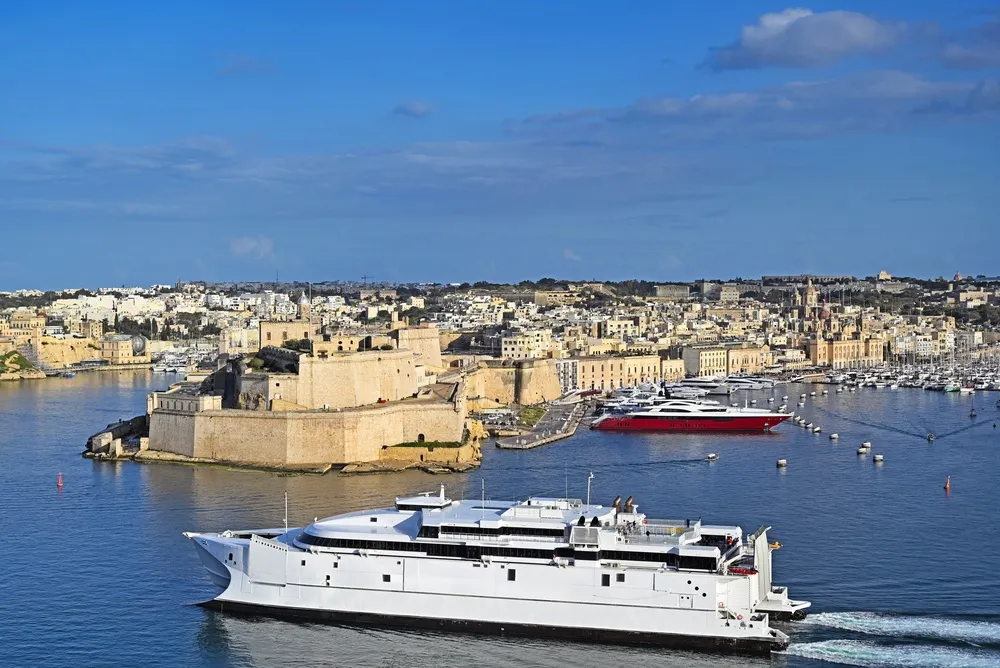 A catamaran leaving the Grand Harbour past Fort St Angelo. Arriving by sea is the best way into Malta — when the weather lets you.
The thing to understand is weather. Between October and March, sailings are cancelled or re-timed often enough — whole days in January and March 2026 — that you should never chain the ferry to a same-day flight. Sail early, sail late, and leave the middle of the day alone.
Cruise ships dock at the Valletta Waterfront, a lift ride below the city.
The border, 2026
Malta is in Schengen. Arriving from Italy, Germany, France or most of Europe, you walk from the plane to the baggage belt.
Arriving from the UK, the US, Turkey or the Gulf, you clear passport control — and since April 2026 the EU’s Entry/Exit System registers every non-EU visitor with a photograph and fingerprints on first entry. At Malta that has been slow: three or four minutes a passenger in spring, queues of forty minutes at the worst, the airport doubling its booths in response. British travellers are the most exposed because there are the most of them. The practical advice is not to book a tight connection onward.
ETIAS, the pre-travel authorisation you will read about, is not live and has no launch date. Anything that tells you to apply for it is wrong as of today. Documents and the rest of the fixed facts are in Essentials.
Things that go wrong, and how often
Etna. When it erupts seriously, Catania closes and the ash can reach Malta. In August 2026 that meant nineteen cancelled Malta flights on one day and six days of regional disruption. It happens every year or two, in any month.
Strikes elsewhere. Most flights from Britain, Germany and Benelux cross Italian or French airspace; an Italian or French air-traffic-control strike cancels Malta flights that never touch Italy or France. Usually announced about ten days ahead.
The home carrier. Eight aircraft and one base means a single maintenance problem grounds routes; it did in December 2025.
None of this changes whether to come. It changes how tightly to plan: a day of slack at either end of a winter trip is cheap insurance.
From the airport to where you are staying
The airport is small, open all night, and everything you need is in one hall on arrivals: the public-transport desk, the taxi booth, the car-hire counters. The decision is about your landing time and your luggage, not distance — nowhere on the island is more than an hour away.
The buses — and the X-route trap
In April 2025 the airport express buses were renumbered and rerouted. The old X1–X4 no longer exist. The Tallinja Direct routes are: TD3 to Msida, Gżira, Sliema and St Julian’s, every 30 minutes; TD2 to St Julian’s and Pembroke, every 30 minutes; TD4 to Valletta and the Gozo fast-ferry terminal; TD1 to Rabat, Buġibba, Mellieħa and Ċirkewwa for the Gozo Channel ferry, hourly; TD5 to the south.
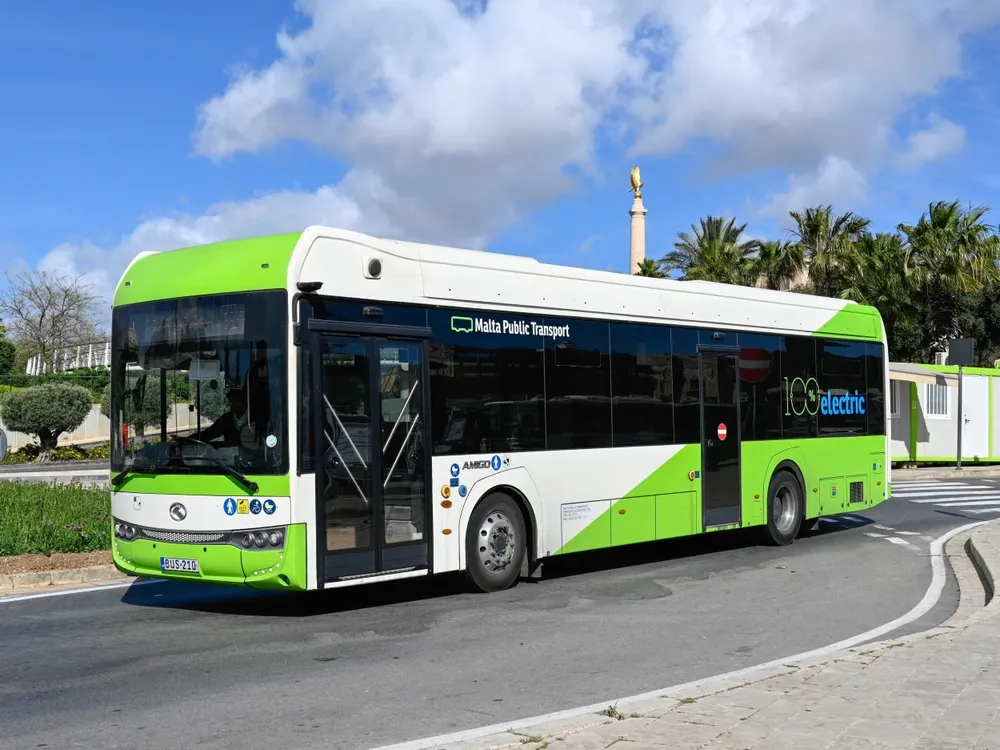 A Malta Public Transport electric bus, Valletta, April 2025. Photo: Chris Lawrence Images / Shutterstock.com
Any guidebook or blog that says “take the X2 to Sliema” is out of date — and that includes the current Lonely Planet. Tallinja Direct carries a premium fare, one step above the ordinary bus, paid in cash or by contactless card on board. First departures around half past five; TD2 and TD3 last departures around half past midnight. A six-thirty flight out from a Sliema base is a taxi, not a bus; a Ryanair landing at one in the morning — common in summer — has no bus.
The fixed-fare taxi
The official airport concession is Malta Taxi. Prepay at the booth in the Welcomers’ Hall by zone — Valletta in the cheapest band, Sliema and St Julian’s one notch up, the far north two — then walk out and board. Staffed 24 hours, no night surcharge, a ten-to-fifteen-minute queue when several late flights land together. After midnight it is often the only option.
Ride-hail
Bolt, Uber and eCabs all operate at the airport with upfront pricing, usually a little cheaper than the booth, collecting from the car park to the left of arrivals. Prices swing twenty or thirty per cent between the three apps, so check two. Between one and five in the morning cars can be scarce; the booth is the safer bet then.
A hire car
Counters in arrivals, collection from the Park East complex. Cars hired on Malta may be taken to Gozo. Before you commit, read Getting around: most travellers conclude they do not need one on the main island.
Onward to Gozo
The Gozo Channel ferry leaves from Ċirkewwa at the far north — TD1 hourly, or a taxi in the top zone. It runs 24 hours, every half hour by day, and you pay nothing at Ċirkewwa: tickets are bought on the Gozo side on the way back. From a late landing there is a second route: taxi to Valletta, then the Gozo Highspeed passenger ferry to Mġarr, 45 minutes, roughly hourly until about a quarter to nine with later sailings nightly in summer. Since May 2026 a new fast ferry also links Sliema and Buġibba to Gozo from March to October. Everything else about the second island is in Gozo.
If you arrived by ferry
The Pozzallo catamaran docks at Pinto Wharf inside the Grand Harbour. You are already in Valletta: ten minutes on foot to the Barrakka Lift and up into the city, or a bus from the terminus. For Sliema, the harbour ferry from Valletta is quicker than any road.
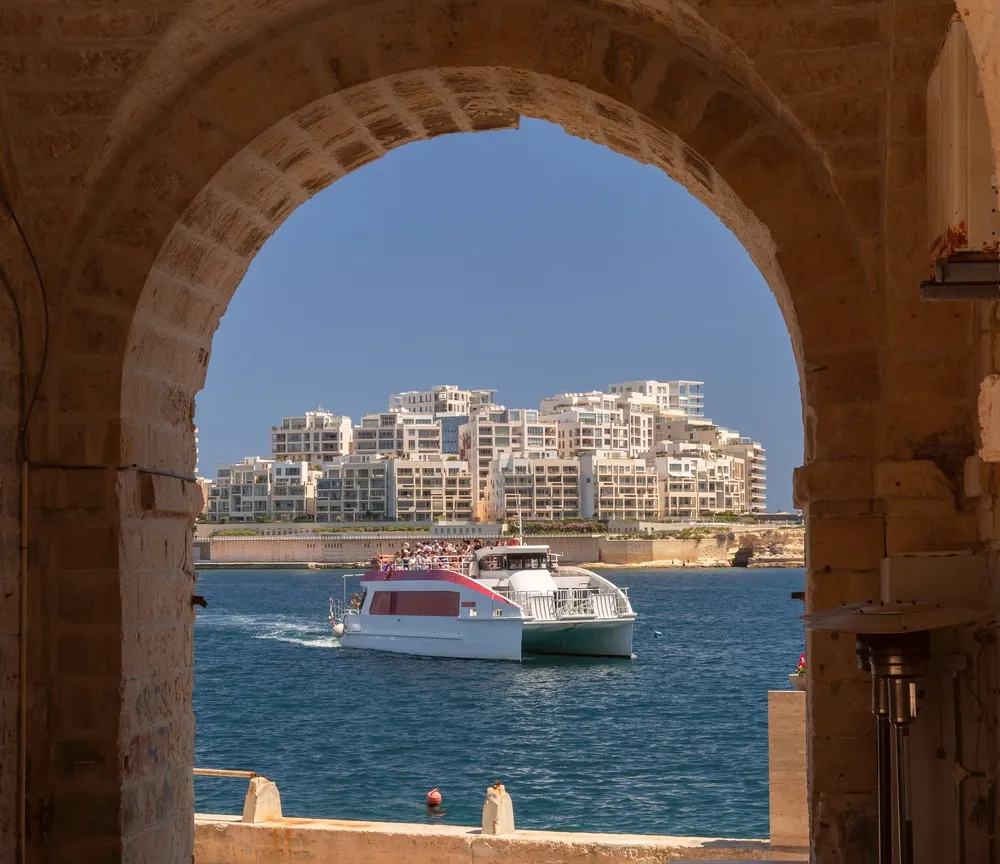 The Sliema–Valletta ferry across Marsamxett: ten minutes, every quarter of an hour, until midnight in summer.